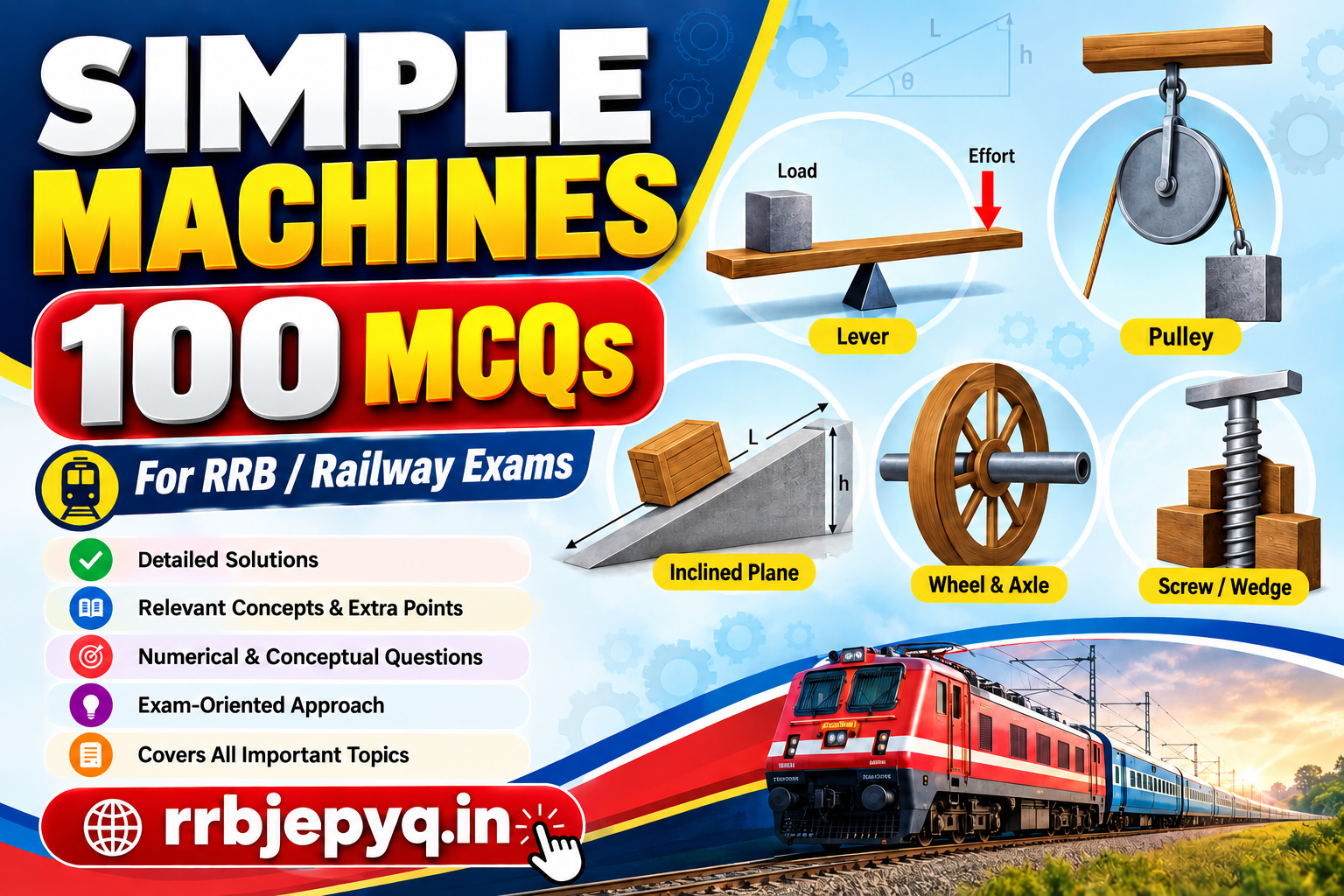
Practice Simple Machine RRB PYQ questions from Railway examinations, including RRB NTPC PYQ, RRB Group D PYQ, RRB JE PYQ, RRB ALP PYQ and RRB Technician PYQ. Simple Machine is an important Physics topic that has been introduced in 2026 in the NCERT Class 9 Science curriculum under the Work and Energy chapter, making it useful for students and competitive-exam aspirants to understand the basic concepts of machines and their applications.
This Simple Machine RRB PYQ collection covers important concepts such as mechanical advantage, velocity ratio, efficiency, load, effort, lever, pulley, inclined plane, wheel and axle, and basic machine calculations. Practicing these questions can help you revise the fundamentals and understand how Simple Machine concepts are applied in Railway examinations.
Whether you are preparing for RRB NTPC Simple Machine PYQ, RRB Group D Simple Machine PYQ, RRB JE Simple Machine PYQ, RRB ALP Simple Machine PYQ, or RRB Technician Simple Machine PYQ, practicing previous year questions can help you strengthen your Physics fundamentals and become familiar with calculation-based and concept-based questions.
Start practicing Simple Machine RRB PYQs and strengthen your Railway Physics preparation.
21
Which is an example of a first-class lever?
✓ Answer:CSeesaw
In a seesaw, the fulcrum is between the effort and load, so it is a first-class lever.
22
The SI unit of work done by a machine is:
✓ Answer:CJoule
Work is measured in joules (J). Since a machine transfers mechanical work, its input and output work are also measured in joules.
23
In a second-class lever:
✓ Answer:BLoad is between fulcrum and effort
A second-class lever has the load between the fulcrum and effort.
24
A machine does not reduce the total work required in an ideal process because:
✓ Answer:BEnergy is conserved
For an ideal machine, conservation of energy requires input work to equal useful output work.
25
Which is a second-class lever?
✓ Answer:AWheelbarrow
In a wheelbarrow, the wheel acts as the fulcrum, the load lies between the wheel and handles, and effort is applied at the handles.
26
Which quantity measures how effectively a real machine converts input work into useful output work?
✓ Answer:BEfficiency
Efficiency = (useful output work/input work) × 100%. It measures how effectively the machine uses the supplied energy.
27
In a third-class lever:
✓ Answer:CEffort is between fulcrum and load
A third-class lever has the effort between the fulcrum and the load.
28
If a machine has an efficiency of 80%, it means:
✓ Answer:B80% of input work becomes useful output work
An efficiency of 80% means 80% of the input work appears as useful output work; the remaining 20% is lost mainly due to friction and other effects.
29
Which is a third-class lever?
✓ Answer:CTweezers
Tweezers have the effort applied between the fixed end (fulcrum) and the object being handled (load).
30
Which of the following is NOT a function of a simple machine?
✓ Answer:DCreating energy
A machine can change force, direction, speed, or distance, but it cannot create energy. Hence, option D.
Showing 21 – 30 of 100 MCQ Questions | Page 3 of 10
![RRB JE Biology [PYQ FREE PDF] Question and Solved Problem with Solution](https://rrbjepyq.in/wp-content/uploads/2026/10/rrb-je-biology-feature-image-300x169.webp)